
Bits of spoilers ahead. Read at your own risk.
I went into Forgotten Island expecting a cute animated movie about being Filipino, with maybe a little American dream thrown in. I came out feeling like I'd been put through an emotional obstacle course.
Sad over Lola. Happy watching Jo and Raissa go on their adventure. Sad again over the thought of them separating. Then suddenly I'm scared of Manang and Batiba while simultaneously wanting to take the little duwendes home because WHY ARE THEY SO CUTE?
Pick an emotion, movie.
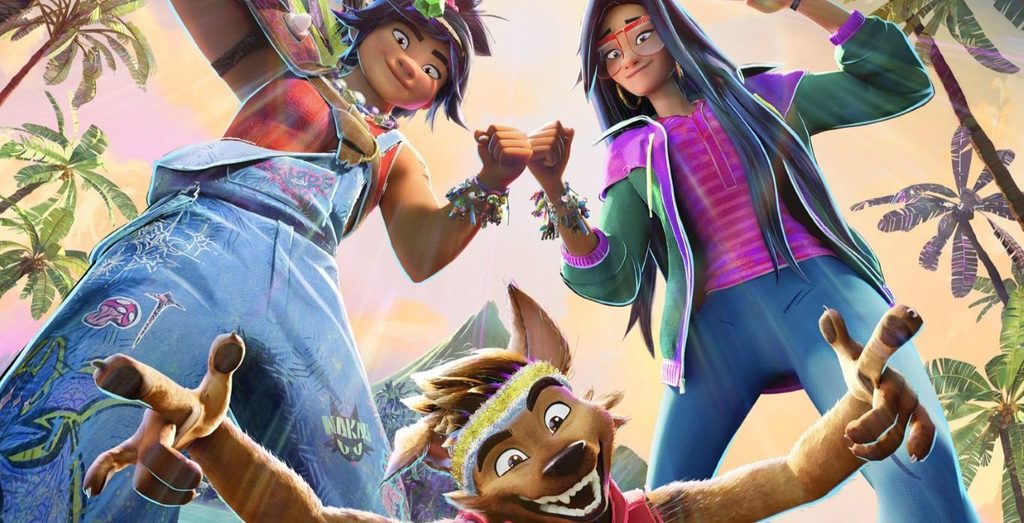
But what I loved most wasn't any particular character or scene. It was how unmistakably Filipino the whole thing felt.
The movie follows childhood best friends Jo and Raissa, whose lives are about to take them in different directions, before they find themselves transported to Nakali, an island filled with creatures from the Filipino stories they grew up hearing. There are duwendes, a manananggal, and other bits of folklore that usually live in stories told by our parents and grandparents instead of on a giant Hollywood screen.
And there we were. Not vaguely Asian. Not a few Filipino references tucked somewhere in the background for us to point at and say, Uy, Pinoy! The family, the food, the language, the folklore, the Lola of it all. Filipino culture wasn't visiting somebody else's story. It was the story.
I know not everybody loved how that story was told.
One criticism I've seen quite a bit is about the Filipino accents. And yes, I heard it too. There were moments when the accents sounded more deliberate than what I'm used to hearing around me every day. But strangely, it didn't bother me much.
Maybe it's because I wasn't watching it expecting it to reproduce Filipinos exactly as Filipinos living in the Philippines would portray ourselves. This is still a Hollywood movie, co-written and co-directed by Filipino-American filmmakers alongside non-Filipino American ones, with a voice cast that includes Filipino and Filipino-diaspora talent.
So in a way, I was also watching ourselves through a Filipino-American and Hollywood lens.
And maybe that's why some things feel slightly different to us here. Diaspora Filipinos don't necessarily experience Filipino culture exactly the way those of us who grew up and continue to live in the Philippines do. That's not automatically wrong. It's another version of the same identity, shaped by distance, family stories, memory, and the way Filipino culture gets carried somewhere else.
Would I have done certain things differently? Sure. Did every joke land? No. Did I occasionally notice an accent and think, Okay, medyo gigil tayo sa pagka-Pinoy doon? Also yes. 😂
And then there's the “Tara na!” versus “Tayo na!” debate, which I've also seen Filipinos arguing about. I get that one too. If I were calling someone to come with me, Tara na! would probably be what naturally comes out of my mouth. Tayo na! isn't necessarily wrong, but to a Filipino ear, depending on the context, it can hit a little differently.
Funny enough, I think that debate proves part of my point. There's a difference between knowing a language and knowing the tiny nuances of how people who use it every day naturally say things. Those of us who grew up here will pick up on those differences immediately, while someone who grew up Filipino somewhere else may use the same language a little differently.
And honestly, I find it kind of funny that we finally have a major Hollywood animated movie centered on Filipino culture and one of the first things we do is argue over whether it should be Tara na! or Tayo na! Very us.
But offensive representation? Personally, I didn't see it that way. For once, we were the ones at the center. And maybe that's why I was willing to give it some room.
Filipinos aren't exactly a tiny, obscure community in the United States. Around 4.6 million people there identify as Filipino, making Filipinos the country's third-largest Asian-origin population. Yet when I think about the big animated movies my kids have grown up with, I can easily name stories rooted in other cultures.
Coco gave us a story deeply rooted in Mexican culture. Moana drew from Polynesian cultures. Mulan brought a Chinese legend to generations of children. Turning Red centered a Chinese-Canadian family. Even Brave gave us Scotland, wild red hair, and an accent my children probably understood better than I did.
And now here's a major animated movie where a Lola tells stories about creatures we know. That meant something to me.
It doesn't mean everybody has to love the movie because it's Filipino. Representation doesn't make a movie immune from criticism, and Forgotten Island isn't perfect. If the accents bothered you, they bothered you. If the story didn't work for you, it didn't work for you. Movies land differently depending on who's sitting in the theater.
You saw things you didn't like. I saw a lot of things I enjoyed and connected with. Both can be true. No need to burst each other's bubbles.
Besides, I was too busy being transported somewhere else entirely.
The movie is set in the 1990s, and maybe that's another reason it got me. Jo and Raissa's childhood friendship reminded me of relationships before smartphones, group chats, location sharing, and the ability to know what somebody was doing every five minutes.
We went outside. We showed up at people's houses. We made plans that required everyone to actually remember the plan. We disappeared for hours and somehow our parents survived without Life360.
How did any of us make it to adulthood?
There was something warm about seeing childhood portrayed that way again, especially now that I'm watching my own children grow up in a completely different version of the world. Their friendships aren't less real because they happen partly through screens, but they're different from the ones we had. Watching Forgotten Island reminded me of how ours felt.
And then there was Lola.
I think most of us have, or had, a Lola whose presence somehow became part of the architecture of childhood. Maybe she lived with you. Maybe you only saw her during vacations. Maybe she fed you every five minutes. Maybe she had stories you only half-listened to because you assumed there would always be another time to hear them.
Then you grow older and realize how much of what you know about your family, your childhood, and even yourself came through people you once thought would simply always be there.
That's probably where Forgotten Island stopped being just a cute Filipino movie for me.
At its heart, the story is about memory. Jo and Raissa discover that staying on Nakali could cost them the memories of their friendship. It's wrapped in fantasy, monsters, adorable duwendes, and enough chaos to keep children entertained, but underneath all of that is something painfully ordinary: people change, people leave, childhood ends, and we're terrified of forgetting what mattered.
At 44, I think I understand that fear differently than I would have at 14.
I've already forgotten things I once thought I'd remember forever. Tiny details about people I loved. Conversations. Voices. Ordinary afternoons that didn't seem important enough to preserve at the time. Then something happens, a smell, a song, an old photograph, or apparently a DreamWorks movie about a magical Filipino island, and a piece of it comes back.
Maybe that's why I enjoyed Forgotten Island as much as I did. It wasn't perfect, and it didn't need to be.
I got to sit in a cinema and watch Filipino stories, creatures, families, humor, and memories take up the whole screen. I got scared of a manananggal, emotionally manipulated by a Lola, and charmed by tiny duwendes, all while remembering a little bit of what it felt like to grow up here.
For me, that was enough.
Also, Filipino folklore finally made it to a major Hollywood animated movie and they chose the manananggal.
Of course they did. We couldn't ease the rest of the world in with something cute first. 🇵🇭😂
Leave a Thought
Have something to say? I'd love to hear it.
Thoughts from Readers
Loading thoughts...